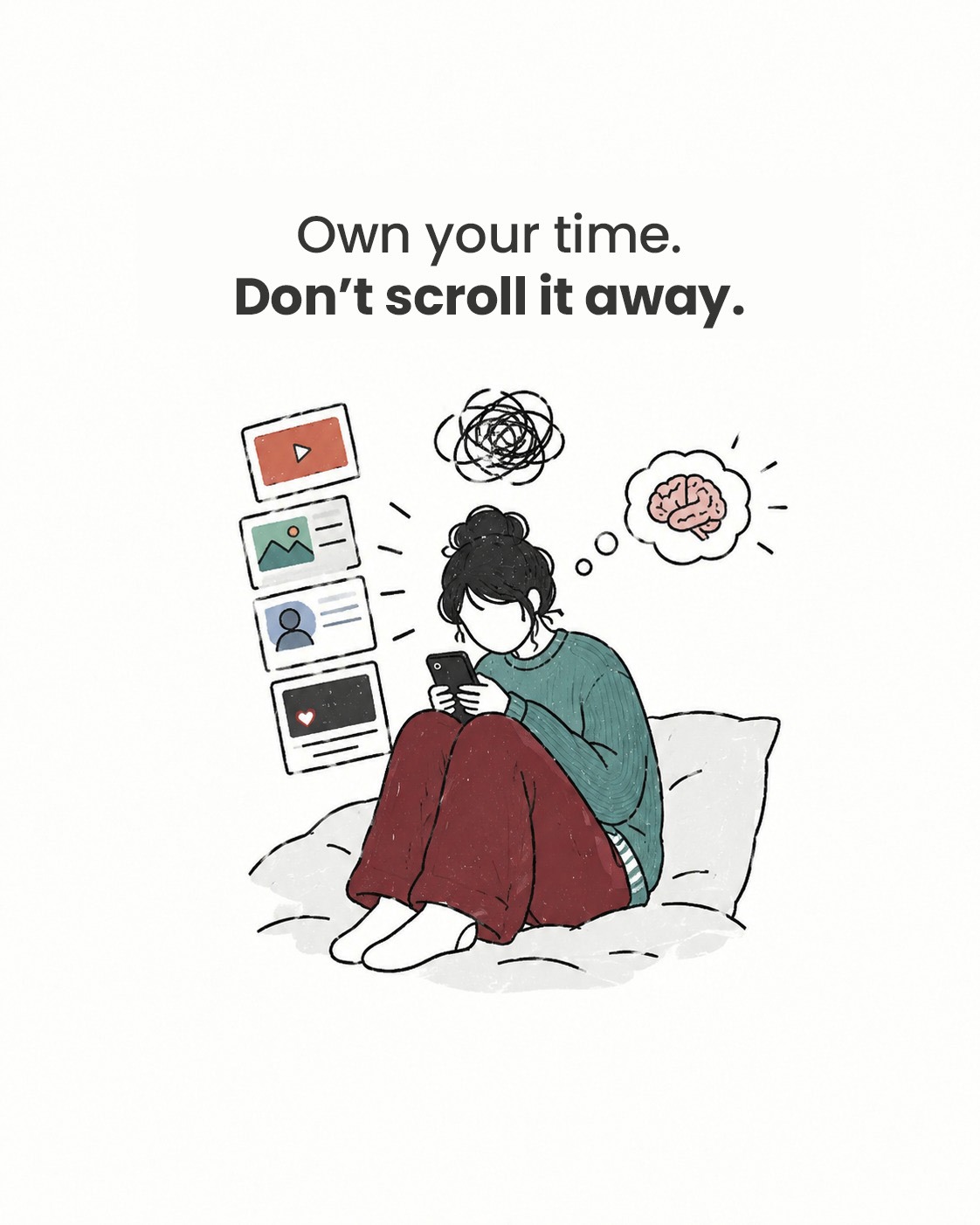
Ever picked up your phone for “just five minutes,” only to look up and realize half an hour has disappeared? You’re not alone. From endless TikToks and Reels to an unending stream of news, doomscrolling has become a familiar part of digital life.
But why can it feel so difficult to stop?
Recent research suggests that the answer may have less to do with simply watching short videos and more to do with how we interact with them. Research discussed in Howtown’s review of “brain rot” found that repeatedly switching between short-form videos may affect cognitive processes such as analytical thinking and prospective memory—the ability to remember an intention.
Importantly, this does not mean that short-form videos are “destroying our attention spans.” A recent systematic review and meta-analysis found associations between short-form video use and cognitive and mental-health outcomes, but also highlighted the limitations of the existing evidence. Much of the research is correlational, meaning we cannot automatically conclude that scrolling causes these difficulties.
Why is doomscrolling so compelling?
Our attention is naturally drawn toward information that is new, emotionally engaging, or potentially threatening. When we feel uncertain, stressed, bored, or worried, checking our phones can become a way of looking for information, reassurance, or simply an escape.
For teenagers, this matters even more. Adolescence involves ongoing development in self-regulation, decision-making, reward processing, and sensitivity to social information—all while young people are navigating school, friendships, identity, and belonging.
Recent adolescent research has found that doomscrolling is associated with problematic social-media use and psychological distress. A 2025 two-wave study of 301 adolescents found that earlier social-media addiction predicted later doomscrolling, while another study of 398 adolescents found that doomscrolling was linked to psychological distress through psychological adjustment.
So instead of asking, “Why can't I stop scrolling?”, a more useful question might be:
“What am I trying to get from scrolling right now?”
How can we help teens take back control?
The goal isn't to eliminate social media. It's to move from automatic scrolling to intentional use.
1. Identify the trigger.
Before opening an app, ask: Am I bored, stressed, lonely, curious, or looking for reassurance?
2. Create a pause.
A few seconds between opening an app and continuing to scroll can interrupt the automatic loop and create an opportunity to choose.
3. Make stopping easier.
Turn off unnecessary notifications, move social-media apps away from the home screen, use app limits, or keep the phone away during sleep. These aren't punishments—they change the environment so self-control isn't required constantly.
4. Choose finite activities.
One podcast, one episode, a playlist, an article, or messaging a friend has a clearer stopping point than an infinite feed.
5. Build other ways to regulate emotions.
If scrolling is being used to cope with stress or overwhelm, replacing it with nothing won't work. Music, movement, talking to someone, journaling, being outdoors, or taking a genuine break can provide alternative ways to regulate.
6. Reflect without shame.
Ask: “Do I feel better after scrolling?” “Did I choose to keep going, or did I just continue?”
The goal isn't to be a perfectly screen-free teenager. It's a teenager who can notice what is pulling their attention, understand why, and decide what they want to do next.
That is what taking back control looks like.